

Is Getting Into College Harder Than Ever?
Breathe slowly into this paper bag. There you are. Getting into college has never been easier.

I’m kicking off The College Question with a countdown called “Ten Things We Get Wrong About College.” It’ll be one a day for ten weekdays, with detours on the weekends. Let’s go!
#10: “Getting into college is harder than ever!”
It’s just awful, isn’t it? As everyone knows, high schoolers have only half a chance of getting into college at all and the losers are sent to work at Panera until Social Security kicks in. There is wailing and rending of Hollister clothing. It’s basically Squid Game, because Nobody Gets Into College.
The Very Short Version
This is not true. Getting into a high-quality college has never been easier, and here’s why. Not too long ago the U.S. college system enrolled 18 million students. Colleges built buildings and budgets and departments to handle 18 million, but now there are 16 million. Any other industry in this situation would shrink (probably through mergers) until supply matched demand, but colleges don’t really do that. They just compete like crazy for as many of the 16 million students as they can get.
One effect of this competition is high admissions rates; another is falling average prices. The second one is tomorrow’s topic.
So in short, Caitlyn and Aidan are definitely getting into college, and will not be forced to sling Toasted Frontega Chicken Sandwiches at Panera until their autumn years.*
*Whether the conclusion here necessarily follows from the premise will be the subject of many later posts on TCQ.
The Slightly Longer Version
Confession: I’m guilty. On a dare, I once wrote an article for The New York Times that supports the College Admissions Doom narrative, “This Is Peak College Admissions Insanity.” It was basically about getting into the Ivy League, and yes, that is currently stupid. More on that this weekend. And if getting into an Ivy League school is The Only Thing That Matters to Makayla, well, Godspeed to her. But if we’re talking about getting into a good four-year college, it really is just the supply and demand story I told above. Here’s the enrollment data:
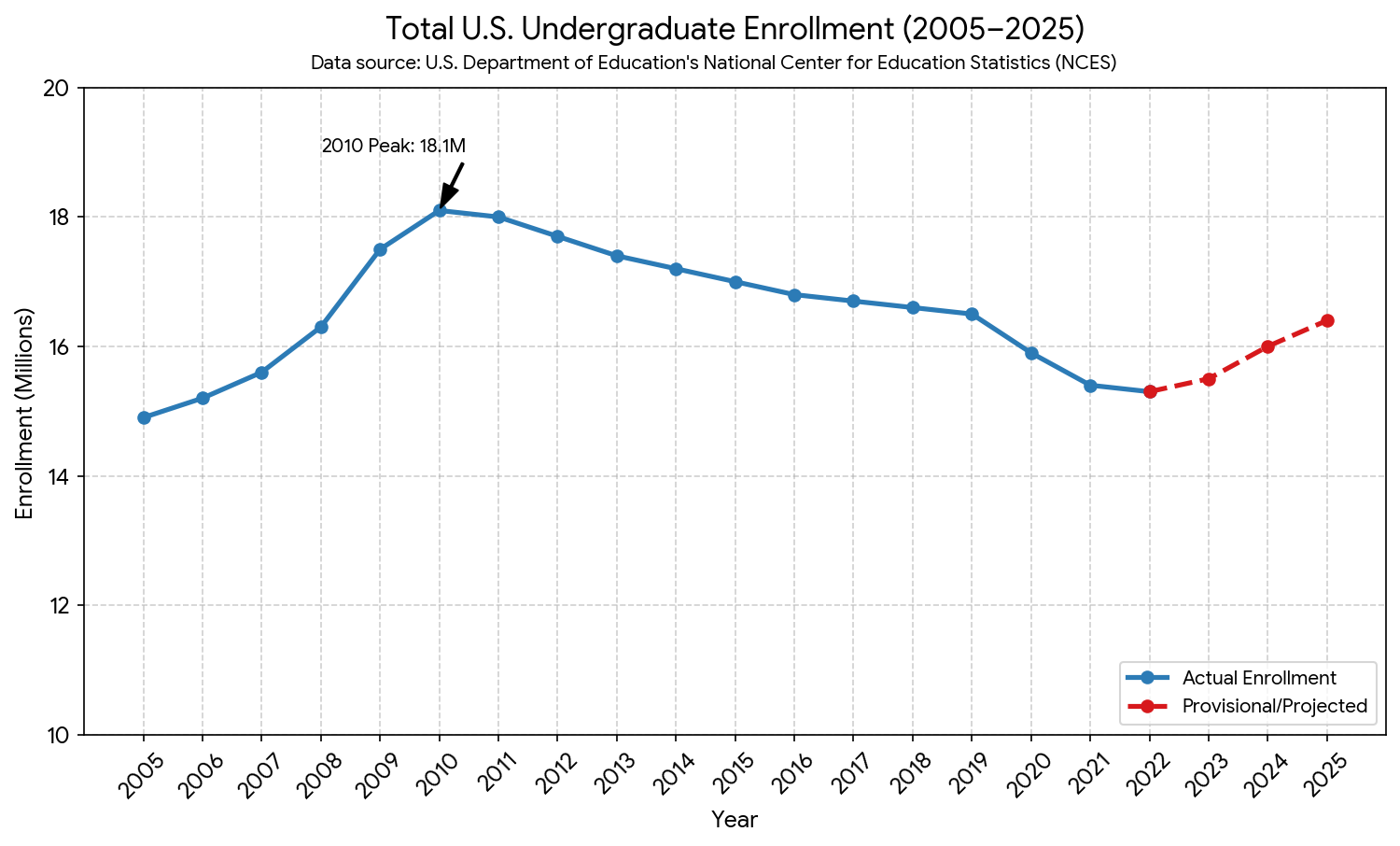
Here’s what it means for admissions. To take an example local to me, the University of Minnesota is a top research university, the sort of place where if you do well you’ll get a great job or get into Harvard Law or whatever. In 2010, when enrollment peaked, the acceptance rate was around 50%. Now it is just under 80%, which in practice means that Minnesota accepts every qualified applicant. This isn’t unusual; colleges accept 60% of applicants on average, and it’s not uncommon for high-quality schools to accept 80%.
Some of you are now thinking that my sense of quality must be off. Surely our impossibly handsome child will be surrounded by morons if he doesn’t at least go to Cornell?
Let me get into that a bit.
One point is that selectivity and quality aren’t necessarily related. If ten geniuses apply to a school that takes ten students, everyone will get in and the school will be full of geniuses. And if an unqualified student somehow gets into the University of Southern California (it’s a hypothetical - just go with me here), does that make USC a bad school? It does not.
Another point is about, you know, education. I hear chemistry textbooks say the same thing at Harvard as they do at the University of Alabama. I’m not a chemistry guy, but that’s what people say. Elite schools do not have any secrets, and because people who get their Ph.Ds at elite schools can’t all stay and teach there (to their great regret), there are hundreds of colleges with faculty holding elite Ph.Ds.
So am I saying it makes no difference if you go to Alabama or Dartmouth? Well … no. They’re pretty different.
But when experts compare outcomes for graduates of elite schools to outcomes for similar students who graduated from non-elite schools, they struggle to see a difference. One view, which you may have heard from Malcolm Gladwell, is that it’s worse to go to Harvard. That’s provocative, but a little hard to defend - though his talk at the link above is quite good. The simpler point is that success is really about the student, and the school doesn’t matter so much. That’s the point of a 2011 study by some folks at Princeton. The elite school isn’t the differentiator; the talent and drive to get into an elite school is. In nerdspeak, it’s the selection effect that matters, not the treatment effect.
More recently, researchers at Harvard confirmed that general point, but added a detail that everyone in New York and D.C. already knew: the fanciest jobs in those towns go to people from the fanciest schools. I have been to those places and I did not get there on a turnip truck, so I can tell you that this is true. Also, you may have noticed that the research was done by people at Harvard and Princeton. So yes - there’s some stuff you can do far better on elite college letterhead, like getting lots of attention for a study saying it doesn’t matter much if you go to an elite college.
Harvard Law School often posts a list of the colleges attended by their entering class, and while it includes Princeton and Yale and Stanford, it also includes schools like California Lutheran and Christopher Newport, both of which accept 80% of applicants. I went to law school at the University of Chicago, and it was the same way. My classmates came from Brown and Georgetown and … wait, how do you pronounce that? That state has colleges? And, in my case, Gustavus Adolphus College. (As for pronunciation, it rhymes with nothing. Forget it.) Top graduate schools know these places produce plenty of strong graduates.
And see this list of colleges whose graduates have won Rhodes Scholarships. A Rhodes is easily the most prestigious scholarship in the world, and on the list you’ll see loads of non-selective schools. Luther College in Decorah, Iowa, for example, has eight. (Our son goes there, which is why we know the place.) You’ll also notice a ton of Rhodes Scholars from elite schools. But keep in mind the selection effects - there’s probably an elite-school advantage, but it’s still mainly about the student.
So Why Do We Think It’s Hard to Get Into College?
There is a lot I could say about this particular hallucination, but let me make three points.
First, we focus on elite brands. Since getting into Stanford is basically impossible, we infer that it must be at least a little like that everywhere else, too. That is not true.
Second, some programs are genuinely hard to get into, even if the college that hosts the program is not. For example, the University of Illinois accepts 50% of in-state applicants, but just accepts 22% of engineering applicants and 7% for computer science. When a particularly smart kid gets rejected from engineering, people talk about it. When half his peers are accepted to the college, nobody notices.
Third, people are drawn to scarcity — and schools have figured this out. Most colleges just let people think they are harder to get into than they really are, but a few go right ahead and …
… well, with regret, let me return to the University of Minnesota. Below, an admissions page as it appeared about two weeks ago. The second sentence is missing something important, and the whole thing is - well, you can judge for yourself.

Here’s a clip from Minnesota’s public disclosures. They admitted 33,000 applicants. That is not “a competitive admissions situation.”
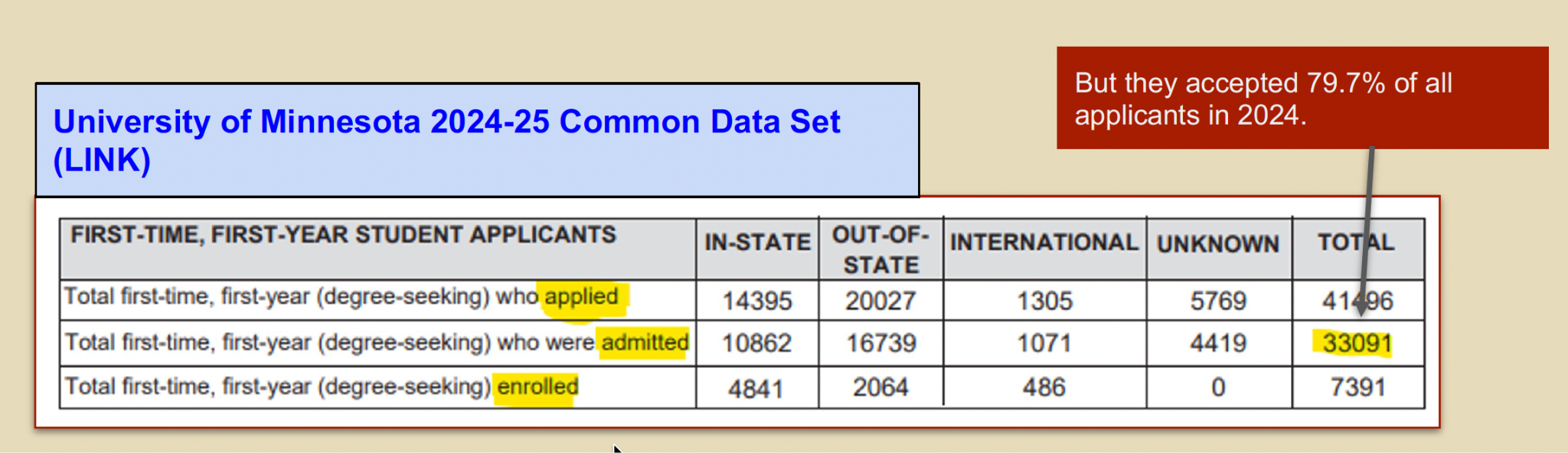
But the appearance of scarcity sells: they got 7,500 more applications this year, perhaps because students heard the news that it was a “competitive admissions situation.”
Some schools have ridden exactly this kind of false-anxiety train to the promised land – i.e., the belief that they are selective leads so many students to apply that they eventually become selective. More on that in a later post, too.
In Conclusion
Your kid is getting into college.
dgc
****
This post was written under the watchful eye of Lavender, who was waitlisted at Tulane. Poor dear. She hasn’t decided where to go to college yet - but really wants my toast.

Coming up …
Friday: #9 - College is more expensive than ever! (Tuition has been flat for 15 years.)
**Weekend Mystery Content!**
#8 - Ugh. We have to fill out the FAFSA. (Probably not. Here’s what to know.)
#7 - Colleges are closing! (No school you’ve ever heard of is going to close.)
#6 - There’s a college debt crisis! (No. But there’s a grad school debt problem.)
#5 - Ugh. Caitlin needs to take the SAT. (What for? Let’s get into it.)
#4 - Well, I guess a sports scholarship is the ticket. (They’re mostly fake.)
#3 - I bet expensive schools spend a lot on the student experience. (Sometimes, if they feel like it.)
#2 - Ivy League graduates make the big bucks. (Not usually - for pretty obvious reasons.)
#1 - Aidan should go to college in [country], where it’s free! (It’s not, which is one of the reasons nobody does this.)
Rarely does such a breezy read sneak in so much substance. Great stuff Dan!
I loved this, Dan. Both the content and tone. I would say you have a gift for this, but I know you have honed your craft through years of diligent effort.