

Presence and Persistence
A Gustavus Keynote, Part 2

In Part 1 of the Gustavus Keynote, Knowledge and Strength, I considered the college motto, e caelo nobis vires, roughly “from heaven come our strengths.” In Part 2, I talk about the conditions necessary for building strength, and discuss what it feels like to be beckoned by a device at all times. I dip very briefly into Habermas and his ideas about lifeworld and system-world in connection with our device-mediated culture. Then I consider another snippet from Gustavus history, contrasting what the Minnesota Swedes were doing in the 1860s to what the Iowa Norwegians were doing at the same time.
*
Presence and Persistence
Building strength requires certain conditions – because it generally requires sustained effort. A weight training session or hockey practice or cross-country training run can’t be interrupted every 40 seconds with a DM notification or a new TikTok video and still succeed. For the same reason, we’ve figured out that it’s pointless to be in a lecture or class discussion if half the class is watching March Madness or answering texts. Instead of reading the class intently, they are skimming it – just one exchange among many. That’s not how deep learning happens.
Being half-present is even less likely to build strength of character, the mix of physical and emotional strength gained by living inside the hard stuff. Strength of character comes from seeing things through from start to finish, from living in the discomfort, the failure and the awkwardness – and coming out the other side. We can’t do that if it’s always possible to reach into our pocket and escape, to displace the virtue of persistence with the habit of perpetual exit.
By now you can tell I’m talking about the pre-reading I asked you to do, Cal Newport’s New York Times Guest Essay, “There’s a Good Reason You Can’t Concentrate at Work.” One of his main points is that we are never fully present when our pocket or purse contains a smartphone, always promising an escape from the moment with a dopamine hit. If the phone is around, it beckons. So does the smartwatch.

But we’ve done a brave experiment this morning – our devices are all in the hall. For many of us, it’s the first time we’ve been in a room without devices for months, maybe years. It changes the dynamic, and I want to talk about it.
*
We paused for 10 minutes to talk about being device-free. Two feelings were shared by nearly everyone: relief and anxiety. Great to have the phones gone. And – what’s happening in my phone? From the front of the room I can testify that, to an extent I haven’t felt since the very early 2000s, when someone was talking there were 25 pairs of eyes on them. Nobody was looking down. Nobody was mentally absent. As I said in the pre-session email that announced the device ban, we partied like it was 1899.
*
Let me offer a postscript on the smartwatch. I wear a dumbwatch. It has Charlie Brown on it, and his arms move in unnatural directions to indicate the time. A recent study found that 57% of teens couldn’t immediately tell the time from an analog clock or watch, and many can’t read it at all. Now, I can’t read a sundial, I can’t drive stick shift, and my family thinks I can’t make a salad. Agree to disagree. So I will concede that not every skill is critical. But it is critical to challenge ourselves to learn unintuitive things like reading an analog watch. It’s a base-12 and base-60 circular arrangement that’s not intuitive at all. The move to digital watches is just one of many examples in which a tidal wave of convenience and ease has delivered a real improvement and in so doing removed one of the little challenges that helps us grow.
Another example. It will be no tragedy if shoelaces cease to exist someday. But learning to tie shoes is one of the ways a child develops manual dexterity, spatial awareness, and the confidence of knowing that they can overcome a challenge. It’s tricky and requires persistence. At the earliest, a child might learn to tie shoes at the age of four. In the past, most had done so by the time they started first grade at the age of six.
But elastic laces and Velcro and whatever else have made it easier to defer the task. Teachers tell me that while grade school kids pretty much all learn to do it eventually, some are in fifth grade when it happens. This involves less struggle, since they are older and more able when they learn. It involves the same amount of learning, but it builds less strength because it was easier.
Back to the Gustavus motto, where we ask heaven for strength. It would be easier to ask heaven to make our problems go away — then less strength would be required. If ours was a story involving a genie in a lamp, perhaps that’s how it would go. But a life of ease is usually a life of weakness, and there’s little virtue in that. There’s also no vision – who is motivated by a life of ease?
We assumed there would be challenges and trusted God to give us the strength to meet them. It has worked out.
Balancing Life and System
Jurgen Habermas was one of the great philosophers and social scientists of the 20th century. He died recently and was eulogized by Cass Sunstein, a former professor of mine from Chicago. Reading Cass’s piece got me thinking about one of the enduring ideas Habermas gave us: he said modernity involved living in two worlds at once. One is ‘the lifeworld,’ which is relational, meaningful, governed by mutual understanding and shared experiences. It’s humans being humans. To that, complex societies have added a ‘system-world.’ It’s instrumental, transactional, governed by money and power. It creates the value we depend on. The system world gives us cars and buildings and medical care.
Habermas says that in the modern era, the system-world has increasingly colonized the life-world. Even the most natural things about us – communication and meaning and relationships – are increasingly mediated by the system. Advertising and business systems create meaning for us, and we seamlessly orient to those things no different than we would to the meaning we make ourselves.
To extend this idea to the present, now we carry the system-world in our pockets. There is no life-world moment — meal, conversation, prayer, walk, lecture — that is not a tap away from being colonized by the system.
What does this have to do with strength? Many people think our smartphone-based reality is at least partly responsible for the tidal wave of mental health issues young people now experience. I don’t have total confidence in this thesis – but I tend to agree. The mental health issues tend to involve an anxiety-based retreat into a narrower world, preferring virtual experiences to the physical act of breathing the same air as others, looking them in the eye, talking face to face. Real-world interactions with people you don’t know well build strength because they are always a little risky and stressful. We risk rejection, disagreement, disappointment and more. People are unpredictable, challenging, boring. It’s easier to check your DMs and watch a video, or ten, or a hundred. Can you imagine telling someone even ten years ago that you just watched a hundred videos in a row? It would sound like a sadistic project for a communications class. But now it’s just Tuesday. It’s a very different world, and we’re getting some unwelcome results.
*
AI could make this stuff better in certain ways, by freeing us up from the system to a degree. (Much modern life is spent interacting with deterministic systems that squeeze our messy reality into boxes. Basically, our world runs on databases. AI might reduce that, or make it easier to do.) Or it could make things worse in some way we haven’t imagined yet. Or probably a little of both.
What is already clear of course is that AI is rapidly transforming the kinds of jobs you used to get right out of college. Reading and analyzing information – whether it’s numbers or words, marketing or accounting or writing. The work I did in my first two years as a law firm associate could be done in a few days, and almost for free, by Claude. In the pre-AI world that work took me about 3,000 hours and cost clients around half a million dollars. That was 1998. Claude is also better at it – so there are huge quality and cost benefits. Those were not a very happy 3,000 hours, but they paid my student loans.
With robots doing the grinding analytical work, what are humans for? Humans are still essential for the other 20% of what I did (plus most of what the partners did): judgment, creativity, decisions, initiation. Delivering a hard message to a client, maybe convincing him that a plan is risky. This kind of stuff takes strength, and it relies on who we are, not just what we know.
Building strength is not the same as learning, which can come from a moment of insight or reading a few paragraphs. Strength is the character growth that comes from doing hard things.
Scrappy From the Start
I want to tell the story of Andrew Jackson, the second president of Gustavus who took the job when the school had almost no resources and a gaggle of irregular students, and in the course of thirteen years grew it into an institution with an established curriculum and the Old Main building we still use today.
From the start, Gustavus was a Swedish school, so you may wonder why a guy named Andrew Jackson was president. It’s a good story.
In 1828, Anders Jacobsson was born on a Swedish farm, one of twelve children. He planned to attend Uppsala University, but his parents died, so he joined the crew of a ship bound for America. On arrival in New York, he jumped ship, which is kind of like disembarking … except it’s a breach of contract. Andersson had apparently promised to work for several voyages, but decided he’d rather just stay in America.
He moved into a seaman’s hostel and quickly got into debt trouble. To elude his creditors, he changed his name to Andrew Jackson. Surely he figured he would blend right in with a name like that. Now, Andrew Jackson, the 7th President of the United States, had finished his term just 15 years before, so it was as if Jacobsson had re-named himself George Bush. But it seems to have worked.
With a new name and some broken English, Jackson fled the city to work at a sawmill, then headed to Wisconsin where he emerged as a lay preacher among Swedes. He still had no higher education. Since pastors were expected to be educated, Jackson enrolled at Augustana College and Theological Seminary in Illinois, where he studied for a year, was given a degree and ordained. Pastors were in short supply and Jackson had the talent and the drive. They did what they needed to do.
He returned to Kandiyohi County, Minnesota, but thirteen members of his church were killed by a Dakota raiding party in 1862, so everyone fled and Jackson had no job. At that point, Eric Norelius asked him to take over as principal of the fledgling Minnesota Elementskolar – which would become Gustavus - and Jackson took the job.
As I said, we were scrappy from the start. A guy on the run from eastern creditors with a year of higher education was running an operation that didn’t know if it was a high school or a college. He made it work. And he couldn’t have imagined an institution with 30,000 living graduates, one that still uses the Old Main that he and his fellow Swedish pioneers built.
It wasn’t like this for everyone on the frontier. I think the school most similar to Gustavus today is Luther College in Decorah, Iowa. The two schools are very similar now, but their beginnings were different, and I think the differences that remain today are downstream from how they started.
Here’s the Luther story in a nutshell. In 1861, the year before Erik Norelius founded Gustavus, a group of Norwegians decided to establish their own college. They hired a university-educated professor from Norway, found a spot in Decorah, Iowa, and by 1865 had completed an enormous four-story Gothic Main building.
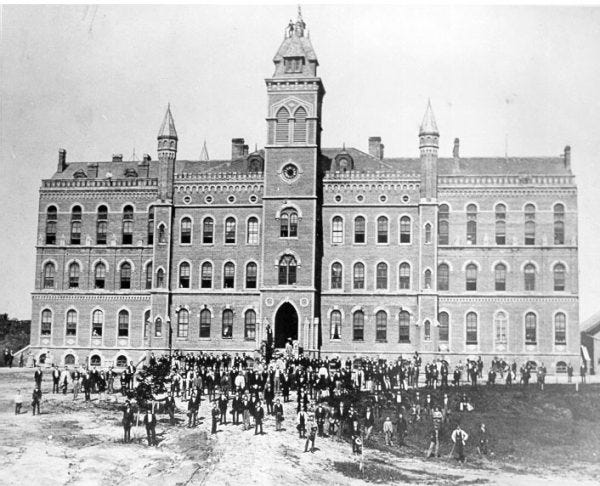
From the start, Luther had a five-language curriculum requiring students to learn Greek, Latin, German, Norwegian and English. That curriculum remained until the 1930s. Luther educated only men until the second world war, when it became coeducational.
When Luther’s university-educated professors were teaching five languages, Gustavus was led by the former Anders Jacobsson, talented and hard-working, with fluent Swedish, broken English and a smattering of Greek. Gustavus was a high school and a college at the same time; the difference between the two wouldn’t be clarified until decades later.[1] It enrolled students between the ages of 13 and 25, giving each student what they needed depending on ability, funds, travel, harvests and the vicissitudes of pioneer life. It was a teachers’ college, a business school, a music school, and a “Literary and Theological Institute.”
In short, it was a bunch of people doing what they needed to do. They were scrappy.
To be continued
[1] Other People’s Colleges: The Origins of American Higher Education Reform by Ethan W. Ris is illuminating in many ways that explain how places like Gustavus and Luther evolved into “colleges” in the late 19th and early 20th century. The idea that high schools (also called academies) and colleges were necessarily different things was a somewhat late development. High schools sometimes awarded bachelor’s and, in rare cases, master’s degrees. Colleges often educated teenagers as young as 13 or 14. Order was imposed - sometimes quite forcibly - by delegates of Carnegie and Rockefeller who found the situation too chaotic for their taste. The Carnegie Classification system is downstream from those efforts.