

Knowledge and Strength
A Gustavus Keynote

Last week I delivered the keynote at a staff retreat at Gustavus Adolphus College, where my wife and I met in the 1990s and I am on the board. I’ll split it up into a few pieces. Today, I confess to a crime and consider the college motto.
E Caelo Nobis Vires
I’m going to talk about the Gustavus motto today – the Latin one, on the seal. Why I think we chose it, and why it’s still perfect for us. And I’m going to talk about strength, and in particular some research that shows how we build it through experiences and relationships in the college years. That’s where we’re headed.
The (Attempted) Mattress Heist of 1993
But first, I’d like to confess to a crime. It was the Mattress Heist of 1993, a break-in with a getaway car, like the recent daring caper at The Louvre, except if it had been done by people who were bad at heists.
I spent my junior year at Oxford, which is on trimesters, so you’re not done until almost the middle of June. I came back to campus to spend the summer of 1993 teaching math. (To myself. That’s another story.) I found a place to live with one of my closest friends, who is now a highly regarded professor at a respected university, which will seem like a surprising outcome after you hear the rest of this story.
My buddy, who I will refer to as Scott to protect the half-innocent, had an apartment in town that had almost everything we needed. That did not include windows – it was someone’s basement. It did include some elements of a kitchen underneath all the unwashed plastic dishes, a couch that generally matched the dishes, and a TV. I remember that we watched a good deal of Beavis & Butt-Head on that TV. The fact that we were immersed in Beavis & Butt-Head sets the scene pretty well for what happened next.
Because the apartment had just one mattress, and after I arrived there were two of us. I spent a few nights sleeping on the couch that matched the dishes before one of us observed that there were around 2,000 unused mattresses in St. Peter, and we knew where they were. We planned to borrow one for the summer.
We got into Scott’s Ford Probe, a car that was kind of like a Prius but sportier and with less storage space. The plan was for Scott to drive up to the front door of the CoEd dorm, drop me off, and pull around to the back. I would go in, find my quarry, and then drag it a few hundred feet across what is now the softball field to his car. The idea, I think, was to elude the gaze of campus security while we got the mattress into his car.
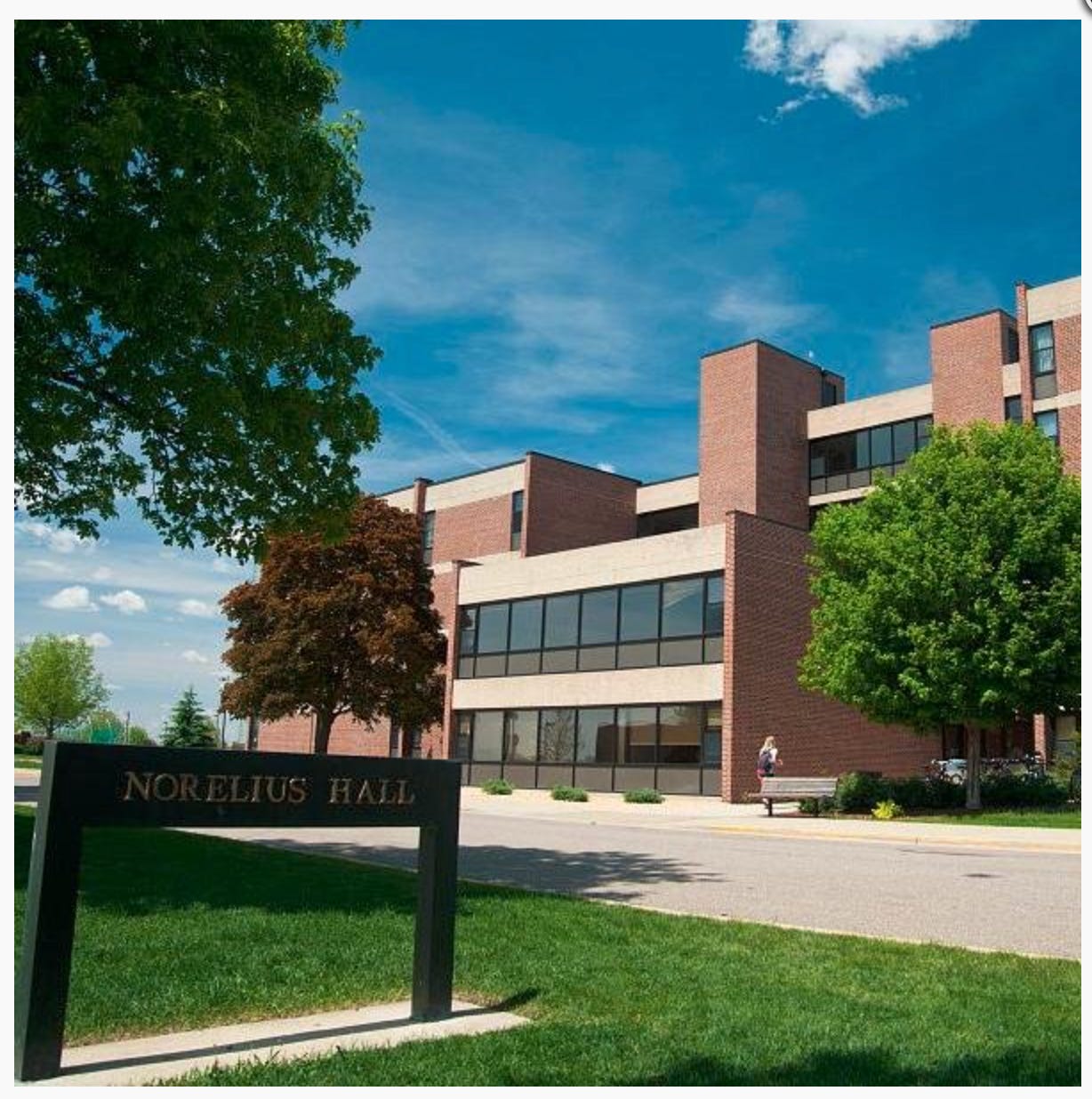
We did elude campus security – they were nowhere to be seen. We did not elude the Saint Peter Police, who it turned out can identify a mattress heist pretty easily when it looks like this:
A guy and a mattress emerge from the back utility door of the CoEd dorm.
Mattress and guy hustle across an open field for 200 feet, or however long a regulation softball field is. It was like Pickett’s Charge, but dumber, and with a mattress.
Mattress and guy arrive at an obviously waiting getaway car, at which point the perpetrators have no idea how to fit a Twin XL plastic mattress into a Ford Probe.
As I sat in the back of that Saint Peter Police cruiser, I thought – this is a surprising way for college to end. Campus security was consulted, which resulted in Steve Waldhauser being consulted – he was the head of Res Life in those days. To my great relief, no charges were filed, the mattress was returned, and I had a date to meet with Waldo the next day.
I was back on the couch that night, and I did not sleep well. I do not remember the details of the meeting the next day except that it involved tearful groveling and resulted in some assigned community service. I got off easy, you could say, which had to do with the fact that I had no prior record of heists, mattress or otherwise. I was a heist virgin, and Waldo could tell, given how good I was at heisting.
For whatever reason, my community service couldn’t happen until school started again in September. I did my penance by spending the Labor Day weekend screwing towel bars onto the backs of dorm room doors in CoEd. As it happened, the first time my wife ever laid eyes on me – I had been gone for the entire preceding year, remember – was that weekend. She was a CF, and I was walking around in overalls with a cordless drill screwing towel bars onto the backs of doors. It was not love at first sight. She understandably assumed I was not a student. There is obviously a lot more to that story, which would not develop until much later. Given that it started with me wearing overalls, that too may not be a surprise.
How Strength is Built
As I said, I want to talk about strengths today. How we build strengths in ourselves and in students, and what conditions we need in order to build them. So let’s turn to that.
Our kids are in college now. We have two, plus a bonus child who was given to us in the form of our son’s “randomly assigned” freshman-year roommate at Luther College. (It wasn’t random. I don’t believe there is a renegade molecule in the universe.) We have been reminded by the ups and downs of these years that strength is shown in the successes – the play that finally turns out right, the year-long research project that eventually does make it onto a poster-board for the big presentation, the grad school application with a happy ending. But that’s not how strength is built. Strength is built in the moments when you’re groveling in front of Waldo because of the dumbest attempted heist in world history, or you finally turn off the light and go to bed, believing that the paper really never will get done, or walk out of a rehearsal knowing in your heart that this play will be nothing but an embarrassment.
Nobody has ever stood up at their retirement party and said, “I am the person I am today because of my Hawaiian vacation in 2007.” We are transformed by the hard stuff. Our strengths come from the work and the failures and the suffering. Not just what’s intellectually hard, but when the challenge becomes emotional. We have lifted all we can, and there’s nothing left. We get strong from the weight room, not the jacuzzi. And we don’t get strong alone. Not usually. We are social creatures, so our strengths are built with the support of relationships that help us through the hard stuff. The encouragement of our key relationships gets us through building strength to showing strength.
And strength is built when we know there’s a purpose. Pain that is pointless is just pain. It breaks you down. For pain to build strength, we need to know there’s a calling to something more.
From Heaven Comes Our — What?
I want us to look at the front of these booklets – the college seal. It’s simple – just “GA” and our Latin motto: e caelo nobis vires.
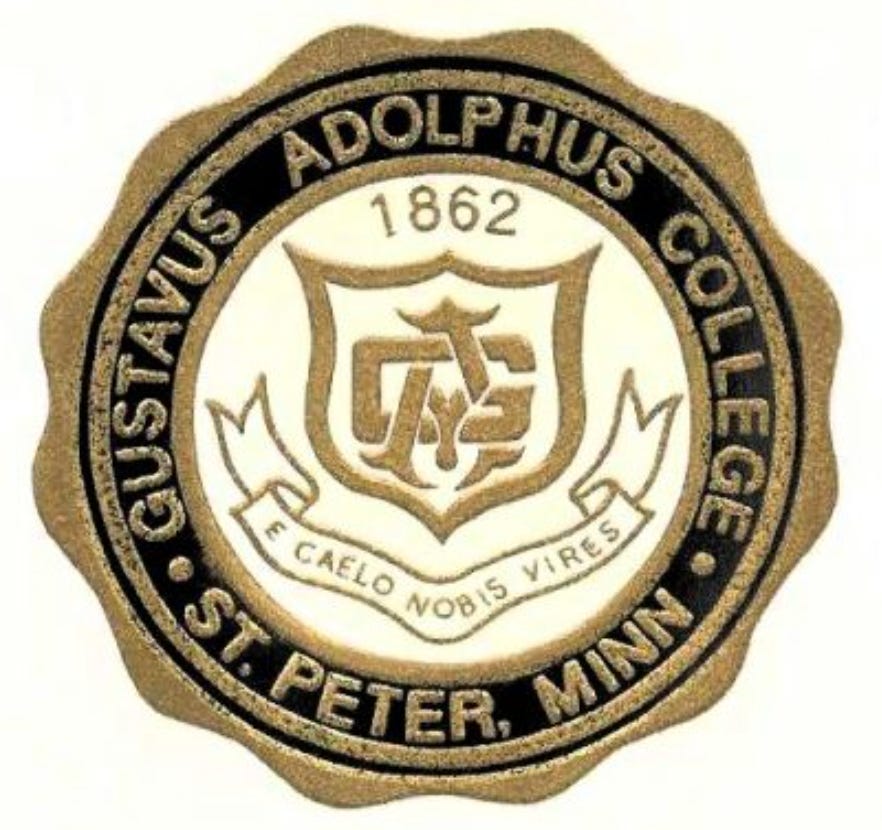
It has been dormant for a few decades. I’ve asked around, and I tend to find that nobody knows what it means. But I think it’s ready for a comeback. Let’s talk about what it means.
Caelo means heaven. Think ‘celestial.’ So, e caelo = “from heaven.” Nobis of course is “ours” or “to us.” So we’ve got “From heaven comes our … vires.”
What’s vires? I always thought it was truth. Harvard’s motto is just “veritas” – which does mean “truth.” So I figured vires is probably related to veritas, and it makes sense for a college motto to be, “from heaven comes our truth.” So for a few decades I wore a Gustavus class ring with – as far as I was concerned – “from heaven comes our truth” on it. (I have an unusual class ring – it’s just the college seal.)
But that’s not what it says. Our daughter would roll her eyes at my ability to be confidently wrong for so long – I think it’s a gift; she has doubts. She’s quite clear that vires means “strengths” – it’s plural.
So here’s the Gustavus Latin motto:
e caelo nobis vires
from heaven come our strengths
On the fact that nobody but the Classics department knows what this means - I’ll let us off the hook on that a bit. The University of Chicago’s motto is crescat scientia; vita excolatur. Nobody knows what it means. Well, not quite. There’s an official translation, which was necessary because nobody knows what it means. Here it is:
crescat scientia; vita excolatur
let knowledge grow from more to more; and so be human life enriched
Somehow four Latin words that nobody understood became thirteen English words that are still a little confusing. With a semicolon. Perfect for the University of Chicago. I think Latin mottos have been ignored for a few decades at most colleges, except at Harvard where the founders took the precaution of making it just one word.
What has been hiding from us for so long, though, is the fact that the Gustavus motto is different from the rest. Chicago’s is about knowledge. Harvard’s is about truth. That’s what you’d expect for a college, right? That’s what this is about. But the Gustavus motto is about strength.
Scrappy From the Start
The people who created St. Ansgar’s Academy, later to be renamed Gustavus Adolphus College, had reason to beg heaven for strength. They had gotten themselves into something and they didn’t know how it would end. They were scrappy, and they did what they needed to do. But they weren’t about to do it alone, nor could they.
Gustavus was started in 1862, on the frontier, by people who lived in wood structures they built with their own hands. Minnesota had become a state just four years before. 1862 was the year of the Dakota War, a series of civilian massacres followed by the largest mass-execution in American history. That happened just down the river in Mankato, the day after Christmas.

The Civil War was raging and some of the Swedish immigrants who founded this place would be swept up in that war. In the summer of 1863, when Gustavus was still St. Ansgar’s Academy, some of them would fight in the Battle of Gettysburg where the 1st Minnesota Infantry Regiment famously gave its last full measure of devotion and, by some accounts, saved the Union. The Swedes who came to this unruly place must have wondered what they had gotten themselves into.
So perhaps it’s natural that their chosen motto was a little different. Oxford’s motto asks God for illumination - dominus illuminatio mea. Yale’s is lux et veritas – “light and truth.” Those are mottos for the life of the mind, for schools where things are secure and the libraries have thick stone walls. That was not the situation in Minnesota in the 1860s. The wind blew through the walls of our library, which was also the classroom and sometimes the cafeteria. We were begging heaven for strength because we needed it.
And we got it, and I think we kept it. It’s in our character. We were scrappy from the start.
To be continued.