Faith on Campus
Some thoughts before summer college visits

It’s June, so high schoolers are out visiting colleges. Lots of questions come up in this process, and I’ll touch on many across the summer. I’ll start with something where I see a lot of confusion: faith on campus.
Some years ago I heard a parent complain that a list of Christian colleges had omitted her alma mater, St. Olaf. She was in a huff, and matters of faith can evoke a lot of emotion, so I didn’t get into it. But what I wanted to say was - “Well, try telling the St. Olaf faculty that they teach at a Christian college and see how that goes.”
It would not go well – which everyone in academia knows, but it’s a confusing situation for families looking at colleges. They see an intermingling of almost identical-looking schools, some of which are historically Christian but fundamentally secular, and some of which are very religious but don’t have religious-sounding names. I skimmed a discussion of this question on one of the big Facebook groups, and let’s just say that it shed more heat than light. People are emotional, which happens with matters of faith — and they are understandably quite confused.
There are, I think, six distinct questions when it comes to faith on campus, and the widespread confusion happens when we conflate them.
Is the college historically religious? Most private colleges are, and in most cases the religious element is gone.
Is the college church-affiliated? Alone, this means almost nothing (but see #3). Some of the least religious schools retain a church affiliation (e.g. Macalester College), and many intensely religious schools have none (e.g. Taylor University).
Does a church affiliation mark a certain philosophy of education? To take a few examples, Jesuit, Benedictine, Lutheran, and Moravian colleges are rooted in philosophies of education that still influence the schools even if there is little faith evident on campus.
Is the education religious? A small subset of colleges are religious in the way many non-religious people appear to think is common. It’s quite uncommon, but it exists - more on that below.
Are the students religious? A public university in the Bible Belt will be more religious in this sense than any church-affiliated school in Massachusetts. Since peers are critical to the faith life of a school, this could be the biggest question - and it’s all but unrelated to a school’s history or church affiliations.
Are there religious organizations? In all cases the answer is yes. Some are national organizations like Hillel (Jewish), Newman Centers (Catholic), InterVarsity, Cru, Fellowship of Christian Athletes, Chi Alpha (all generally Protestant), and the Muslim Students Association. There are also campus ministries like the Christian Study Center at the University of Florida, the Center for Christian Study at the University of Virginia, Hill House at UT-Austin, Chesterton House at Cornell, and Wheelock House at Dartmouth. These vary widely, but many are thriving and some have an impressive range of offerings and growing footprint on campus – like Anselm House at the University of Minnesota, which serves thousands of students with a study center and extensive programming in the center of campus.
So … the confusion about faith on campus is understandable. Let’s take a simpler look at how to figure out where a school stands.

Few colleges expect their students to be religious, so even if a school is named The College of St. Somebody, it is unlikely to have a doctrine-infused curriculum. It is not uncommon for there to be a required religion class – but these are usually religious studies classes, which are a lot more like sociology or history than theology. Some students want the theology track while others want to avoid it; some want a religious environment and others don’t.
How do you figure it out? It’s a two-step process:
Look at the Council for Christian Colleges and Universities list, then add Liberty and Grand Canyon. Those are your more conservative Protestant schools.
Look at the Newman Guide list. Those are your conservative Catholic schools.
The Catholic side is confusing, since most Catholic colleges seem quite religious but are formally independent of the church per the 1967 Land O’Lakes Statement. The Vatican position is that Catholic universities should be closely tied to the church, but — contrary to popular belief — the Vatican isn’t that powerful, so most Catholic schools don’t really comply. The Newman Guide schools are more Vatican-aligned.
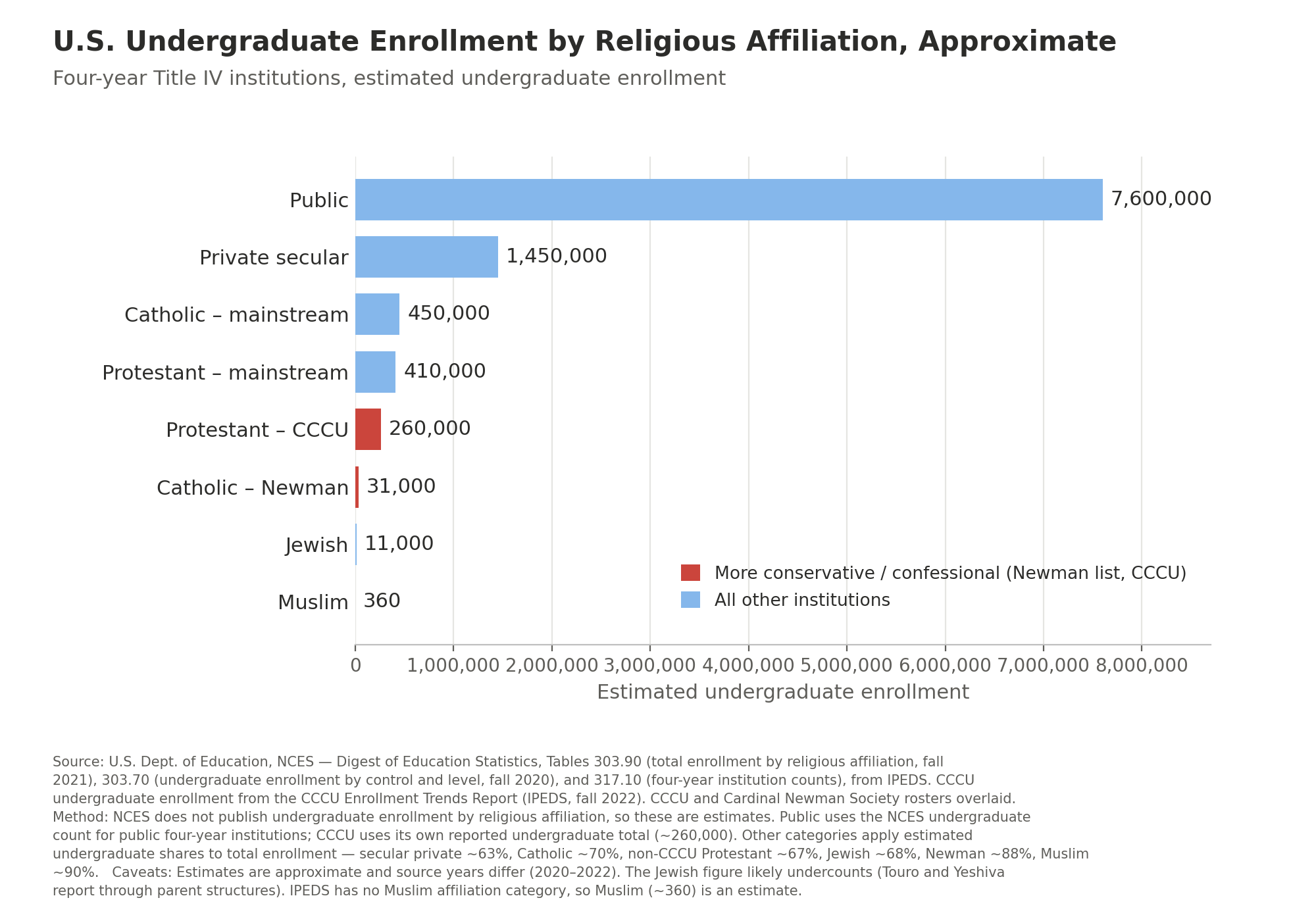
If you combine the CCCU and Newman lists, you’ve got perhaps 200 colleges where the education is in some way religious. That’s about ten percent of American four-year schools, but they tend to be small, so they don’t enroll anywhere near ten percent of American students. Here’s an estimated breakdown of undergraduate enrollment by religious character, with the more religious schools shown in red.
It’s all but impossible to start a new college these days – unlike in the 19th century when colleges were opened in someone’s spare room with a professor and nine-and-a-half students – so there are only a few religiously-affiliated colleges that aren’t either Protestant or Catholic. Here’s the rest of the field:
Brigham Young, of course, is Mormon.
Hellenic College is Eastern Orthodox.
Brandeis is a Jewish-founded university on an open model like the liberal Catholic or Protestant schools, and Yeshiva University in New York is a more conservative Jewish institution. There are around 30 other Jewish-affiliated schools, many of them tiny. The vast majority of Jewish students attend secular universities, with concentrations in certain places. Jewish life on those campuses largely happens through Hillel. (If you’re interested in this at all, I highly recommend the Gatecrashers podcast, which chronicles aspects of the Jewish experience in the Ivy League.)
There are two accredited Islamic colleges: Zaytuna College in Berkeley, California, which offers a B.A. in Islamic Law and Theology, and the American Islamic College in Chicago, which offers a B.A. in Islamic Studies.
There are a few specialized institutions associated with Buddhism and Hinduism, too.
Religion is an emotional thing, so at this point at least someone is fuming along the lines of, “Notre Dame isn’t on the Newman List, and they have a chapel in every dorm and mass every day!” Indeed. It’s not a science. I’ll go a little deeper in the next post.
To be continued …